Updated March 22, with the news of warnings from the Global BioLabs Report 2023. The COVID-19 pandemic has affected the world like never before, with millions of deaths – close to 7 million now according to the Worldometer though global excess deaths are estimated at double or even quadruple that figure – and it has had a devastating effect on economies and societies worldwide. The question of where the virus originated has been a topic of intense debate, with various theories proposed, and a recent rise in investigations showing a probable link to the animal world:
The latest news, however, is coming from a French scientist who has unearthed data that had remained unanalyzed up to now opening new perspectives.
The scientist in question, Florence Débarre, is a theoretician who specializes in evolutionary biology and works at CNRS, the French national research agency. She came upon the data by chance while working on some other topic. The data in question was some genetic sequences taken from a food market in Wuhan and posted by Chinese researchers in GISAID, the virology database (launched on the occasion of the Sixty-first World Health Assembly in May 2008).
This data, if confirmed by further research, would support the theory that coronavirus-infected animals in the market triggered the pandemic.
The media talks of “unearthing” the data, suggesting it was somehow “lost” as it appears to have been quickly removed or erased by the Chinese authorities. Or as the Science journal diplomatically puts it in its article, it can be described as “previously undisclosed genetic data”.
Débarre presented her findings on March 14, 2023, to the Scientific Advisory Group for the Origins of Novel Pathogens (SAGO). SAGO had been created by the World Health Organization (WHO) last year to investigate the origins of the virus as WHO member countries, in particular the US, were not satisfied with the original investigation made by WHO.
WHO issued a statement on the finding on March 18. Let’s take a closer look at what happened and why.
Why the question of Covid’s origin has arisen
Dissatisfaction with WHO’s original investigation in early 2021 had first arisen in Republican circles in the US. arguing that it was not thorough enough and that China was not transparent enough in its cooperation with the investigation.
Republicans were also the first to propose early in the pandemic the theory that the virus had escaped from a lab in Wuhan – a theory also held by the FBI.
However, the lab leak theory was always highly controversial because it was instantly politicized and used to fuel anti-China sentiment. However, at the time, it was dismissed by many scientists and public health experts as highly unlikely.
The prevailing theory among experts back then was that the virus originated in bats and then had jumped to an intermediate host, possibly a pangolin or another animal, before being transmitted to humans.
This was in line with the One Health concept that is gaining traction worldwide – the notion that we are all part of the same interface and intimately connected – humans, animals and our shared environment – a concept that is gaining traction around the world and that we have often referred to in our articles here.
Also, the fact that the pandemic appeared to have emerged first in Wuhan, China, pointed to a well-known market in that town – the Huanan Seafood Wholesale Market that despite its name also sells meat and wildlife.
The Chinese were quick to deny that any wildlife was sold in that market but continuing to deny this will be difficult as a photo taken by Edward Holmes in 2014 is now circulating on Internet, showing a raccoon dog for sale. The Chinese have also, of course, always adamantly denied the lab leak theory.
However, as more information became available, the lab leak theory re-emerged, gaining more attention. In May 2021, President Joe Biden ordered an intelligence review into the origins of the virus, including the possibility of a lab leak. The review, conducted by the U.S. intelligence community, did not reach a definitive conclusion but did not rule out the possibility of a lab leak.
Hence, WHO was led to create SAGO.
What SAGO heard this week about Covid origin
The WHO issued a statement on March 18, four days after the meeting. It describes how WHO had become “aware of new SARS-CoV-2 sequences and metagenomics data associated with samples collected in the Huanan Seafood Wholesale Market, Wuhan, China, from January 2020, that became available on the GISAID platform for a short period of time.”
A number of researchers subsequently downloaded this data but “access was restricted shortly after, apparently to allow further data updates by China CDC”
Then something strange happened: WHO says that it “immediately reached out to China CDC and to the Chair and Vice-Chair of SAGO” and was told that “the genomic data are the basis for an expected update to the existing Liu et al. 2022 preprint (1), which is in the process of being re-submitted for publication to Nature by China CDC.” In short, the world was told by China to wait.
The next event in this saga was the meeting this week, on March 12, organized with all SAGO members, together with China CDC scientists and international researchers – including, of course, Débarre who had “unearthed” the “new” genetic data.
This “new” data included metagenomic data of environmental samples from various stalls and wastewater collection sites collected as early as January 2020. DNA from wild raccoon dogs, Malaysian porcupine, and bamboo rats among others, were found in SARS-CoV-2 positive environmental samples.
The ensuing discussion ended on the following observation pending more research to confirm it, as WHO puts it:
The findings suggest that animals were present at the market shortly before the market had been cleared on 1 January 2020, as part of the public health measures by Chinese authorities. These results provide potential leads to identifying intermediate hosts of SARS-CoV-2 and potential sources of human infections in the market. (bolding added)
As the WHO statement further explains:
The animal samples included animal bodies, frozen animal carcases and animal products, as well as stray animals around the market, and covered 18 species. According to the preprint, raccoon dogs were not amongst the animals tested. However, the presence of high levels of raccoon dog mitochondrial DNA in the metagenomics data from environmental samples identified in the new analysis, suggest that raccoon dog and other animals may have been present before the market was cleaned as part of the public health intervention.
And it concludes:
Although this does not provide conclusive evidence as to the intermediate host or origins of the virus, the data provide further evidence of the presence of susceptible animals at the market that may have been a source of human infections.
In summary, the French scientist’s findings are significant because they provide new evidence to support the theory that the virus originated in the Wuhan market. However, they do not definitively prove the theory, and more research is needed to confirm the virus’s origin definitively.
The WHO statement ends on a strong SAGO recommendation, as mentioned in its preliminary report, that “researchers in China investigate the upstream sources of the animals and animal products present in Huanan market just before its closure and removal of all animal products on 1 January 2020”, and researchers are “encouraged” to make “all available sequencing and metagenomic data” public on GISAID, or any other sequence database.
Lab leak or natural spillover: What if both theories were correct?
Now, there is no doubt that it will be difficult to prove which theory is right.
Could Covid be the result of a “lab leak”? This implies that Chinese scientists surreptitiously created a deadly virus to frighten the whole world into submission (?) or perhaps, less scandalously, merely engaged in incautiously testing a virus and through human error, “creating” Covid and letting it escape.
Actually, the lab leak theory ties in neatly with rising concerns about the growing number of high-security pathogen labs. There are now over 100 such labs and a new analysis from King’s College, London, the Global BioLabs Report 2023, released on 16 March, warns that the growing number of labs is raising risks of an accidental release or misuse of germs such as the Ebola and Nipah viruses.
Alternatively, Covid started in the animal world and “jumped” to humans. But as Joel Wertheim, an evolutionary biologist at the University of California, San Diego, who is collaborating with Andersen and others in the analyses of the newly discovered sequences, says, critics of the spillover hypothesis want more conclusive evidence than science can possibly deliver: “You can’t observe the zoonotic transmission of a novel virus from animals to humans,” he says. “We’re just never going to get that level of data.”
That is of course true. But one may be allowed to wonder whether the solution to this mystery is that both theories could be right. Couldn’t researchers in a lab in Wuhan, possibly engaged in SARS research, have been testing on animals a range of viruses, among them a variant that happened to be Covid? And then the animals – once the tests were over – somehow found their way into the nearby wildlife food market?
Food for thought, especially considering that conspiracy theories and attributing malignant intentions to people – in this case China – often turn out to be mistaken.
The truth tends to be more simple and less exciting: What if the lab in Wuhan did indeed engage in SARS research? A lot of labs did after the world was hit – starting at the turn of the century – by a series of zoonotic diseases, notably Ebola and MERS. Testing on animals is a standard procedure and it requires careful, safe disposal of the animals.
It is easy to imagine a mistake at that level, some workers might have been unaware or uninformed of the possible danger of transmission and one of them might have simply brought a sick animal home, say to please an animal-loving child…Human error is almost always the right explanation in such cases.
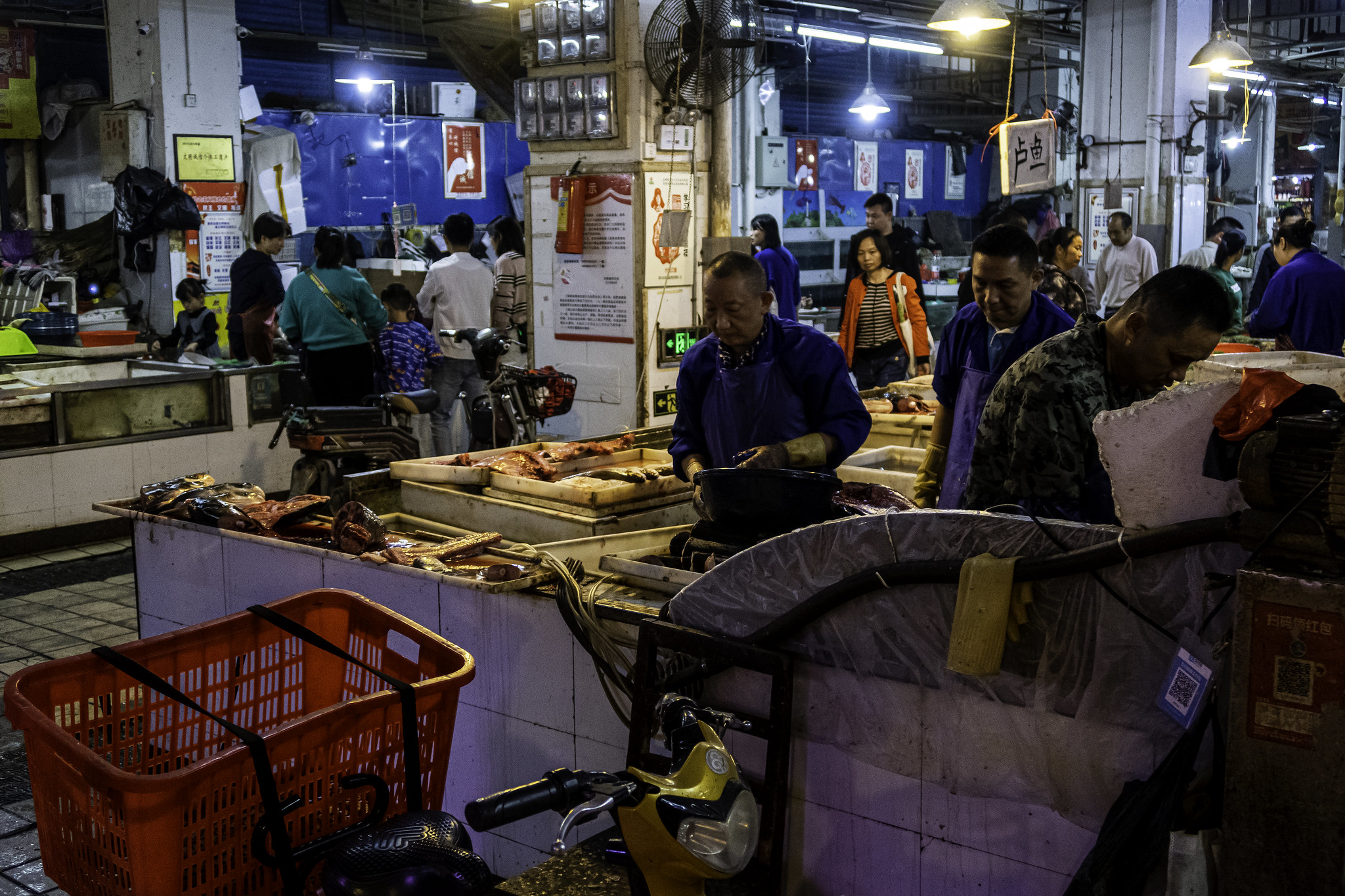
Editor’s Note: The opinions expressed here by the authors are their own, not those of Impakter.com — In the Featured Photo: Men at a seafood stall in Wuhan, China, in November 2019. Credit: Arend Kuester via Flickr. CC BY-NC 2.0. See Laura Kahn’s article in Bulletin of the Atomic Scientists: Coronavirus or Antibiotic Resistance